

Case study: Stabila ČR cut its adhesive consumption by around 50%
After replacing its melter with a Robatech Alpha S, Stabila ČR uses roughly half the adhesive.
Folding rules from Haluzice
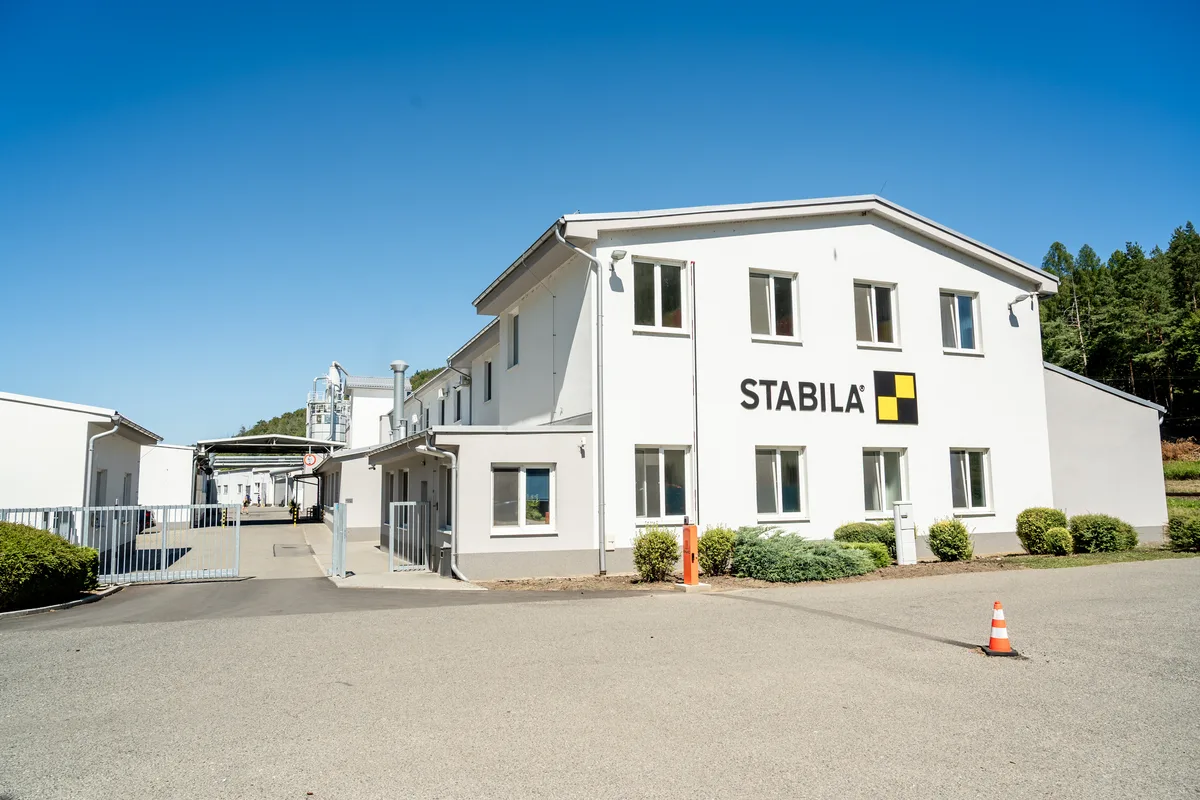
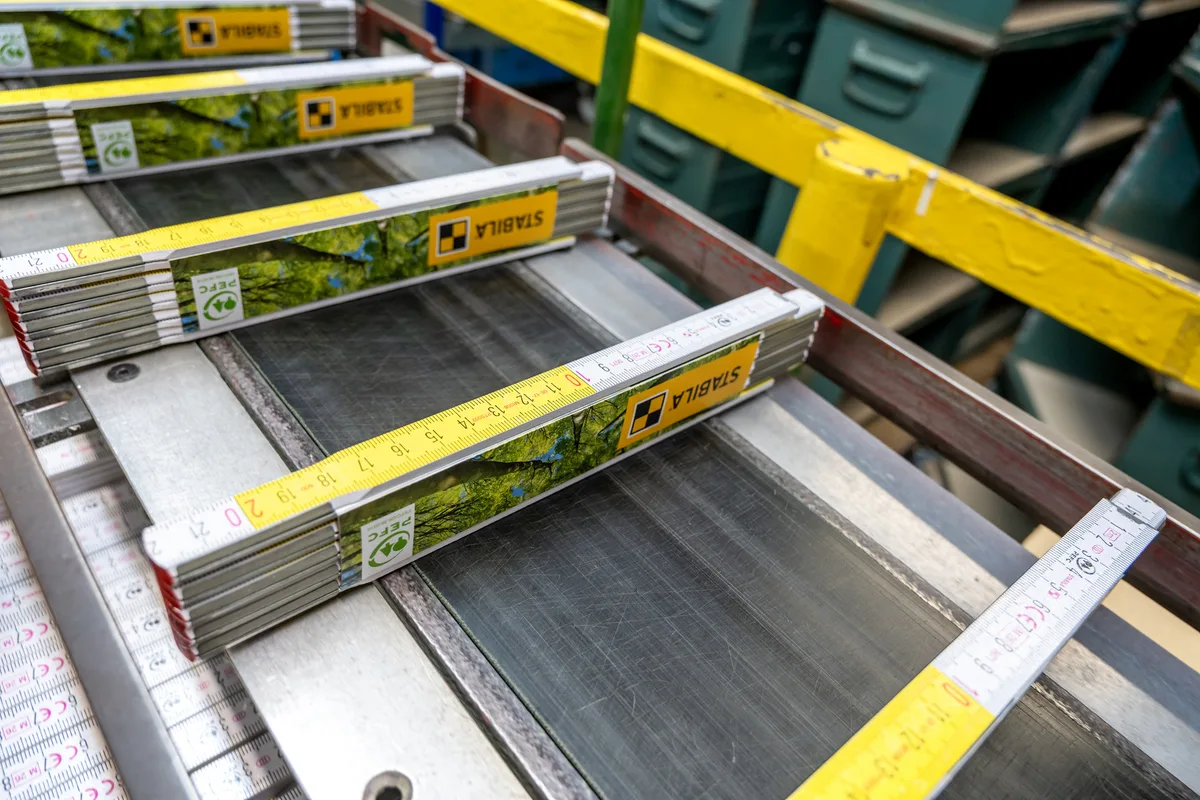
Wooden folding rules have been made in Haluzice since 1993. Stabila ČR employs approximately 150 people here, works two shifts and produces on average around 10 million units a year. Production is spread across several halls, most operations are automated and run at a fast cycle rate. Beech timber from the company’s own sawmill is first dried in two stages and then cut to the required size. This is followed by colouring, printing of the scales, milling of the holes and assembly of the joints. Every step is monitored by a camera inspection system that rejects all imperfect parts. Finally, the rule is riveted, folded and sent on for packing.
The weak spot of an otherwise reliable line
Roughly half of the rules carry advertising print, and one of the types is supplied in a paper sleeve. Fitting the sleeves and placing the rules into boxes is handled by a separate line, one of the oldest in the entire plant. It was moved to Haluzice from Germany in the 1990s. It does not run continuously; it is started up according to orders and, as a whole, has worked reliably for many years.
Last year, however, it became clear that its weak spot was the gluing. The original Nordson melter was becoming less and less reliable, and the quality of the adhesive application no longer met the needs of production. According to managing director Marek Zemčík, it was not possible to fine-tune the adhesive dosing precisely. He describes the consequences as follows: “To be sure the bond would hold, we tended to apply more adhesive, but that led to it oozing out and forming ‘drips’ we weren’t happy with.”
First, find out what is being glued
Stabila was originally looking for a “like-for-like” replacement. The inquiry was sent by Pavel Vachek, head of the technical department, and Kaletech responded to it. Before offering anything, however, Kaletech wanted to get to know the application in detail. Pavel Vachek describes it like this: “A representative of Kaletech responded to my inquiry and asked for detailed information. I described exactly what we needed to glue, what material, how many pieces per shift, and we clarified the parameters of the adhesive bead. Based on real testing, Kaletech then offered us a tailor-made solution with a Robatech melter at its heart.”
The goal was a perfectly glued sleeve. The melter alone cannot guarantee that; the choice of adhesive is just as important. The right adhesive was selected by the sister company Kalep: the low-temperature hot melt adhesive KALEP MC 1400, designed for the packaging industry. The solution was then tested both at the supplier and directly at Stabila. The tests checked how well the bond held immediately after gluing, how it withstood higher temperatures and its strength after a longer period. Stabila ordered the solution only on the basis of the results.
Technology used
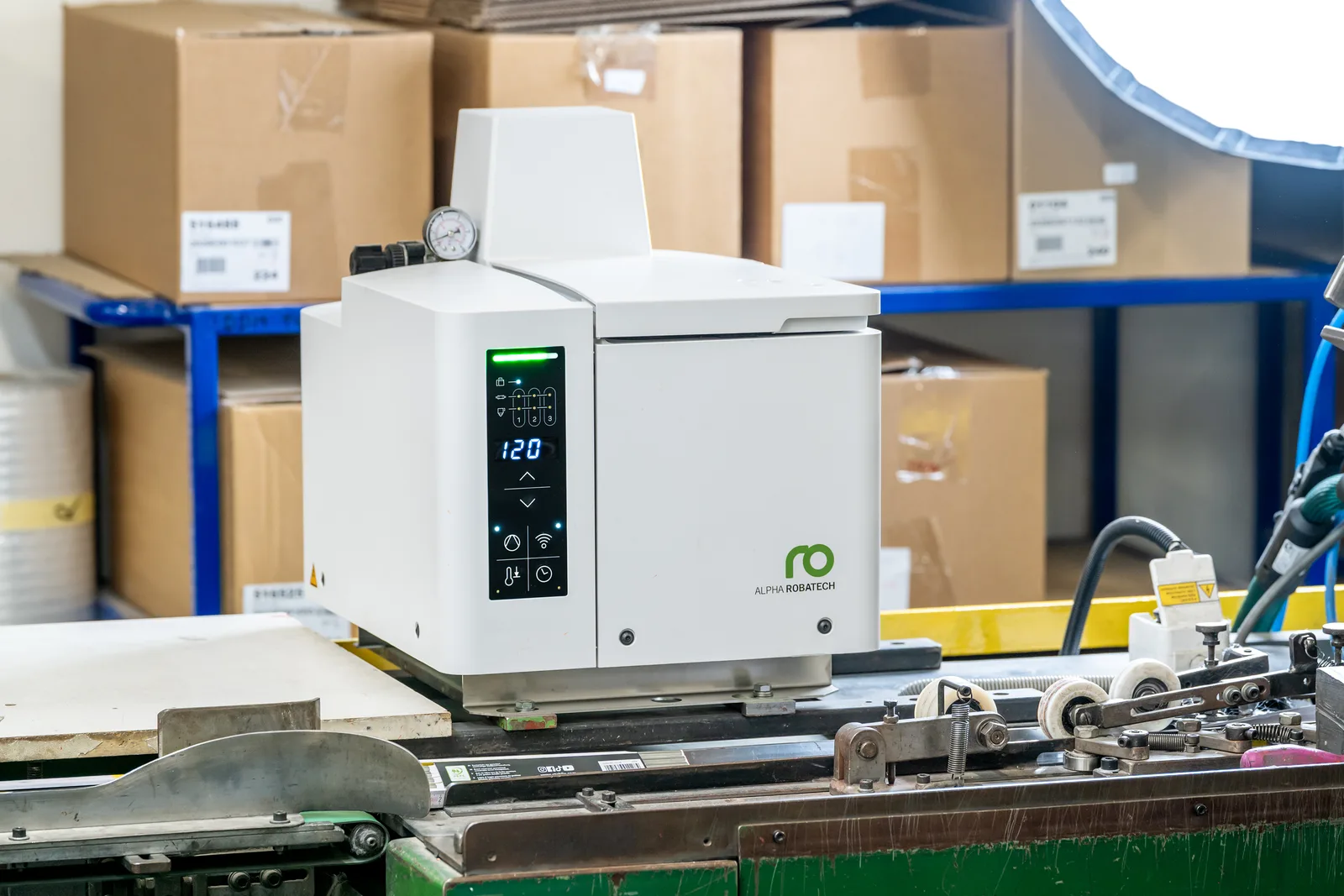
At the heart of the delivery is the Robatech Alpha S melter. A heated hose carries the adhesive from it to the AX Diamond 1 jetting head, which applies the bead to the paper sleeve.
- Melter: Robatech Alpha S
- Application head: AX Diamond 1 jetting head
- Heated hose: NW 6, length 1.2 m
- Adhesive: KALEP MC 1400 low-temperature hot melt adhesive (selected by the sister company Kalep)
A precise bead instead of an extra safety margin
Thanks to precise dosing, there is no longer any need to oversize the bead. Stabila uses approximately 20 kg of adhesive a month, and the new adhesive costs around half the price of the original one. Pavel Vachek adds: “The right combination of melter, nozzle and adhesive makes it possible to create a very precise bead. A colleague from the quality department confirmed to me that the adhesive has better adhesion to the sleeve paper, so just a fraction of the adhesive we used before is enough to achieve an equally strong bond.”
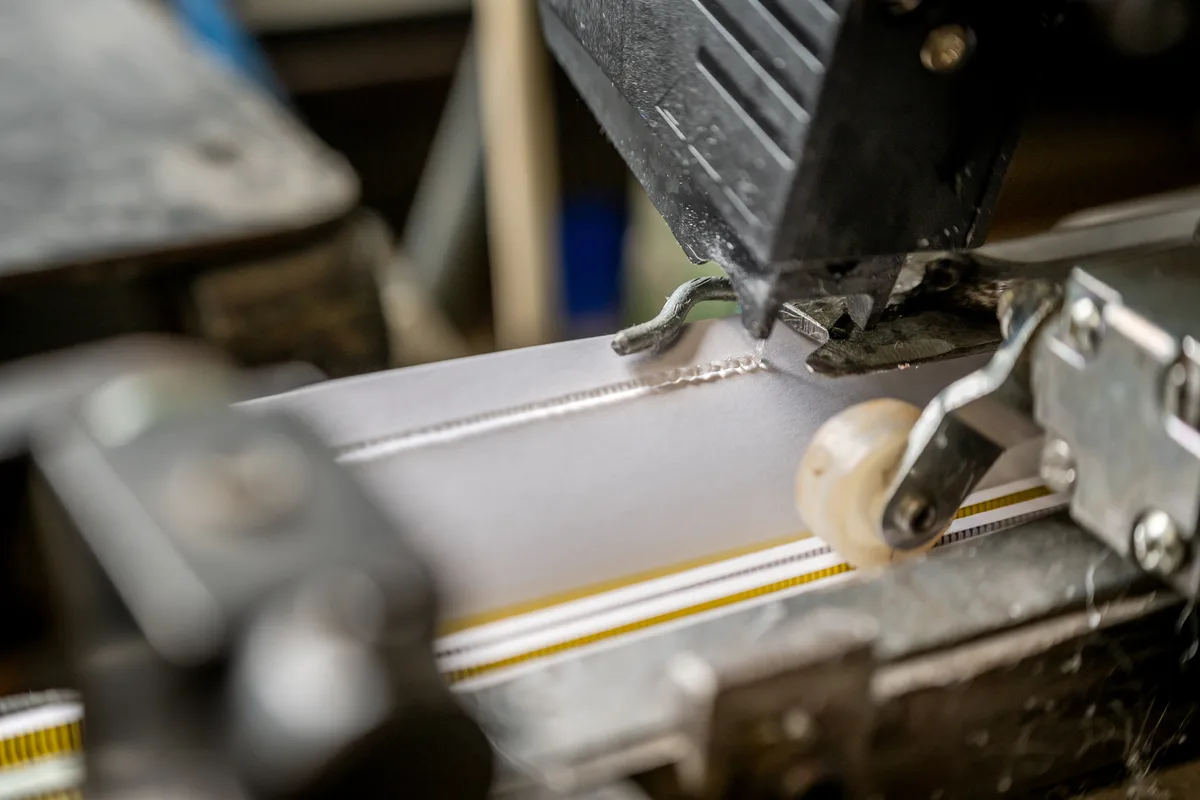
KALEP MC 1400 also melts at a lower temperature than the original adhesive. Production therefore uses less energy, and after start-up the line gets going much faster and more easily than before. The lower operating temperature has a further, more general advantage: the adhesive application system is under less strain and suffers less wear. This reduces maintenance costs and extends the service life of the equipment.
A melter ready for a new line too
Stabila is considering a complete renewal of the sleeve line within a few years. The Alpha S melter can then be used on the new line as well. Kaletech also bought back the original equipment and took this into account in the price of the delivery. According to Stabila, this amounted to a discount of approximately 25%.
Marek Zemčík, however, points out what mattered most: “The main reason for the investment wasn’t cost savings. Above all, we had to replace equipment that did not meet our needs, and we succeeded in doing so.”
What determines the reliability of production is not the age of the equipment, but whether it performs its function accurately over the long term. At Stabila, replacing the melter was all it took: it removed the unreliable link, and there was no need to replace the whole line.
Results
- Adhesive consumption fell to roughly half, because the bead no longer needs to be oversized.
- The new adhesive costs around half the price of the original one.
- The adhesive adheres better to the sleeve paper, as confirmed by the quality department.
- Thanks to the adhesive’s lower melting temperature, energy consumption has fallen and production start-up is significantly faster and easier.
Is there a spot on your line where more adhesive is applied than necessary, just to be safe? We will go through it with you as part of an operating cost audit, or contact our service team. You will find more examples in the packaging gluing and sealing section.